
For house flippers
Know your real profit per flip. Before the closing table tells you
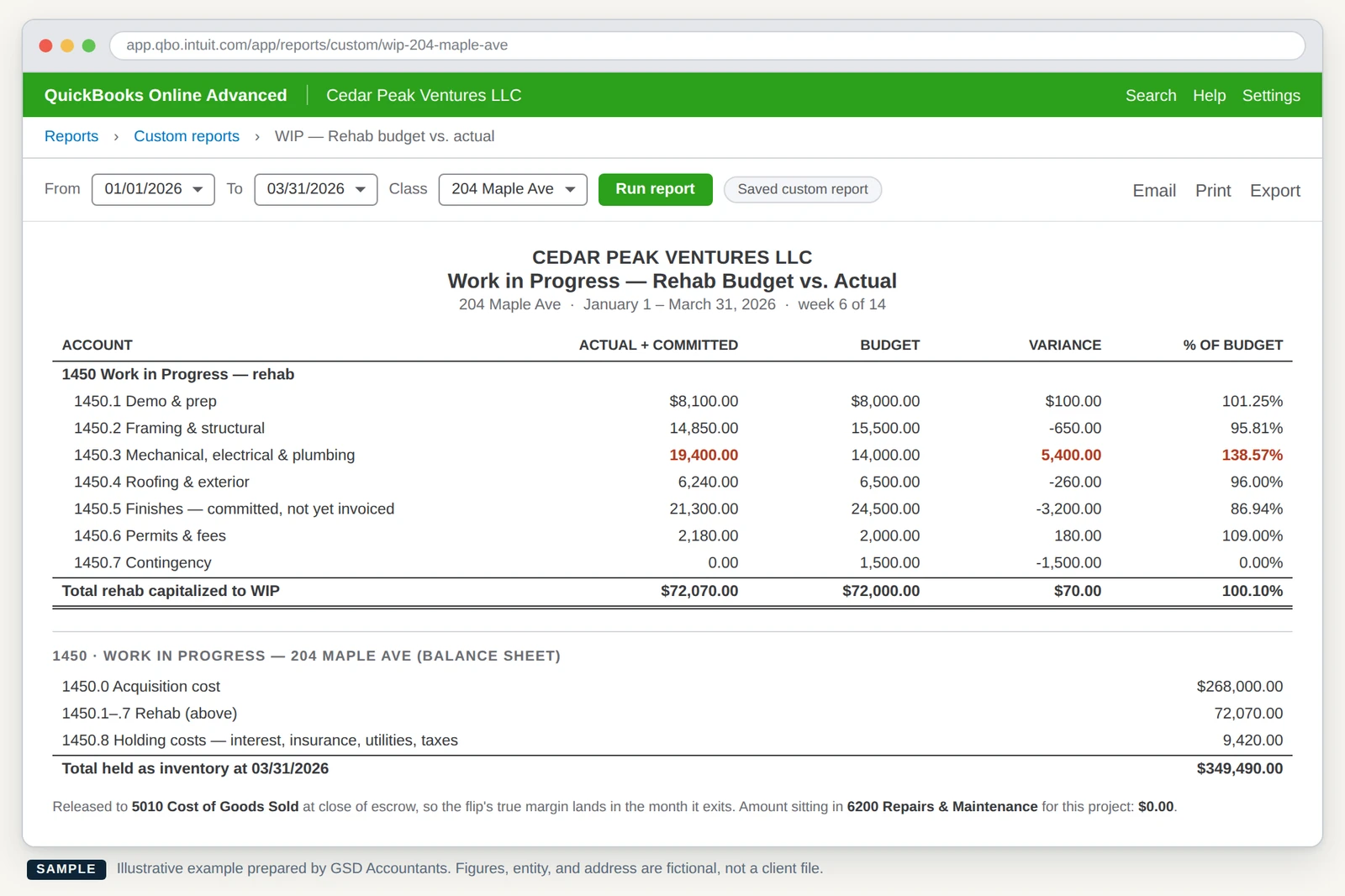
Generic bookkeepers bury your rehab in “Repairs & Maintenance” and your exit math goes with it. We run every flip as a project. Costs sit in WIP on the balance sheet, true COGS lands at sale, and budget variance shows up at week 6, not at listing.
Maple Ave flip
rehab budget $72,000| Demo & prep | $8,100 / $8,000 |
|---|---|
| Framing & structural | $14,850 / $15,500 |
| Electrical & plumbing | $19,400 / $14,000 |
| Finishes (committed) | $21,300 / $24,500 |
| Variance flag | rough-in +$5,400 ⚠ |
Sound familiar?
- Your “profit” changes depending on which report you run
- Rehab costs sit in Repairs & Maintenance, inflating expenses on paper and hiding your real margin
- You find out a project went over budget when it’s too late to matter
- Every hard money draw means a week of digging for documentation
- Your CPA re-does your books every spring, and bills you for it
How we run flip books
- Acquisition, rehab, holding, and selling costs all captured to the project as WIP rather than expensed
- COGS recognized at sale, so each flip shows its real profit in the month it exits
- Every close gives you budget vs. actual per project: original budget, committed, spent, variance
- Hard money draw accounting. Lender fees split correctly, escrow reconciled, and the documentation already packaged for the next draw
- Every transaction gets a per-project QBO class. No exceptions
Free download
The Flipper’s Chart of Accounts
The QBO chart of accounts we install for flip clients. WIP structure, holding cost categories, per-project classes, plus the setup guide. Pair it with the Flip Profit Calculator to model your next deal.
Get the template
Flip bookkeeping questions
Why does WIP matter for a flip?
A flip is inventory, not a rental. Rehab costs belong on the balance sheet as work in progress, and they release to cost of goods sold when the property sells. Book them as ‘repairs’ instead and every month’s P&L is wrong, your margin is invisible, and you carry tax-time risk your CPA unwinds at cleanup prices.
How do you track multiple flips at once?
Every project gets its own QBO class. Every invoice, draw, and labor hour lands on its project. You see acquisition, rehab, holding, and selling costs per flip, and a budget-vs-actual variance at every monthly close.
Do you handle hard money draws?
Yes. Draw tracking is core to how we run flip books, lender fee splits and construction escrow included. The documentation gets packaged so your next draw funds in days.
What does it cost?
Clean Books is $1,247/mo for one entity, plus $147/mo for each additional entity. Running concurrent projects with crews and vendor bills? Back Office is $2,997/mo (plus $197 per added entity) and adds AP and job-costed payroll. Every price and upgrade is published on the pricing page.
Flipping 1-3 a year or running 10 with crews?
Either way there’s a published tier for it. The diagnostic tells you which, and what your cleanup would cost.
Book a 30-minute diagnostic